Acoustic Material Specification in the UAE: Why Projects Fail and How to Get It Right
Acoustic materials are rarely the root problem.
The way they are specified, selected, and installed is.
In UAE projects, material selection is often treated as a procurement exercise. It becomes a cost comparison between suppliers rather than a performance-driven decision.
This is where risk is introduced.
Acoustic materials UAE projects fail not because the products do not exist, but because the wrong materials are selected, substituted, or applied in the wrong way.
This guide focuses on where things actually go wrong and how to avoid expensive corrections at the end of a project.
Key Takeaways
- Material performance depends on how it is used, not just what is specified.
- Absorption and insulation are often confused during procurement.
- Contractor substitutions are a major source of risk.
- Laboratory data does not reflect real-world performance.
- Early design input reduces material-related failures.
The Commercial Risk of Acoustic Material Specification
Acoustic issues often appear at the worst possible time.
At testing. At handover. When there is no programme left.
At that point, the discussion shifts from design to damage control.
This is typically identified through acoustic testing and verification.
If performance is not achieved, materials are often blamed. In reality, the issue is usually how they were specified or installed. Working with an acoustic consultant in Dubai from the outset helps developers and architects avoid these costly late-stage failures.
Performance vs Procurement
There is a disconnect in many projects.
Design intent is based on performance. Procurement is based on cost.
This leads to:
- materials selected based on price rather than function
- substitutions that change performance characteristics
- lack of understanding of how materials interact with the building
This sits at the core of architectural acoustics.
Without that link, specification becomes guesswork.
Where Projects Fail
1. Absorption vs Insulation Confusion
One of the most common issues.
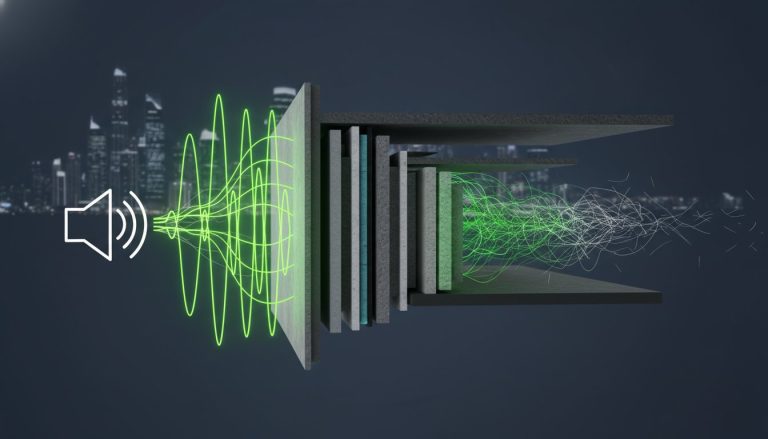
Absorption controls sound within a space. Insulation controls sound between spaces.
Using the wrong type results in immediate performance failure.
2. Contractor Substitution
Minor changes in density, thickness, or build-up can significantly affect performance.
These are often approved without understanding the acoustic impact.
3. Over-Reliance on Datasheets
Laboratory performance is not site performance.
Flanking paths, workmanship, and detailing all affect results. Material selection must also account for how absorption coefficients feed into reverberation time calculation — a step that is frequently deferred until it is too late to influence the finish schedule.
4. Poor Coordination with MEP
Lightweight materials cannot control mechanical noise.
This links directly to building services noise and vibration.
What This Looks Like on a Real Project
A typical scenario:
A high-end office fit-out specifies acoustic wall panels for meeting rooms.
After completion:
- speech is clearly audible outside the room
- privacy is compromised
The issue is not the panel quality.
The issue is that absorption was used where insulation was required.
Fixing this requires rebuilding partitions, not replacing finishes.
UAE-Specific Risks
The UAE adds additional complexity.
- high humidity affects material durability
- temperature extremes during construction impact performance
- fire rating requirements limit material selection
Compliance with UAE Civil Defence and local authority requirements must be considered alongside acoustic performance.
This is not always reflected in international datasheets. Developers navigating these requirements should review the commercial considerations for hiring an acoustic consultant in Dubai to understand how local regulatory nuances affect material selection and project outcomes.
How to Get It Right
The approach is simple, but it needs to happen early.
Concept Stage
- define performance requirements
- align materials with function
Design Stage
- integrate materials into full build-ups
- coordinate with MEP systems
Construction Stage
- control substitutions
- review installation quality
Early involvement through specialist acoustic advisory services reduces risk significantly.
Frequently Asked Questions
Why do acoustic materials fail?
Because they are used incorrectly or substituted without proper review.
Is product data reliable?
It is useful, but it does not reflect real-world performance on its own.
Can issues be fixed later?
Often, but at significant cost and disruption.
How can risk be reduced?
Through early design input and proper coordination.
Final Thought
Acoustic materials do not fail on their own.
Decisions around them do.
The earlier those decisions are made correctly, the lower the risk at the end of the project.