An acoustic laboratory test certificate provides no guarantee that a building will achieve compliance with Dubai Municipality building code once the project reaches practical completion. Within the high-pressure environment of UAE property development, relying exclusively on performance data undertaken in laboratory conditions frequently results in fundamental failures during acoustic commissioning testing. You’ve likely experienced the frustration of a project stalled at the final hurdle because the actual sound insulation fails to reflect the performance specification. It’s an avoidable risk that threatens both handover timelines and commercial reputations.
This guide demonstrates how to manage the on-site acoustic testing process to eliminate these discrepancies and work toward your project meeting regulatory standards. We will examine why site performance often falls short of laboratory results, how to coordinate contractors effectively, and the practical steps needed to secure a successful, complaint-free handover.
Key Takeaways
- Understand why laboratory ratings often fail to translate to real-world performance due to flanking transmission through structural junctions.
- Learn how to strategically organise on-site acoustic testing to identify potential failures early, preventing costly handover delays and remedial works.
- Navigate the specific acoustic requirements set by the Dubai Municipality and national building codes to ensure your project achieves full regulatory compliance.
- Discover why early-stage verification is a fraction of the cost of post-completion retrofits, protecting both your budget and the long-term property value.
- Establish a representative sampling strategy for rooms that satisfies both internal quality standards and external regulatory bodies without disrupting the construction programme.
Table of Contents
-
Understanding the Reality Gap: Why Laboratory Ratings Often Fail On-Site
-
How to Organise On-Site Acoustic Testing: A Practical Process for Project Teams
-
Navigating National Regulatory Compliance and International Standards
-
Protecting Commercial Value Through Early Verification and Site Support
Understanding the Reality Gap: Why Laboratory Ratings Often Fail On-Site
Residential and commercial building developers in Dubai regularly face remediation bills after projects fail final handover inspection and / or testing due to poor sound insulation. Partition systems specified at 55 dB Rw in the design stage, may result in the finished units barely achieving 47 dB. Failures like this are not necessarily a defect of the material itself but a result of the "Reality Gap" that exists between controlled laboratory environments and the complex conditions of a live construction site. The Reality Gap is the discrepancy between theoretical design and physical assembly.
Relying solely on manufacturer data sheets creates a significant commercial risk for developers and contractors. These sheets reflect a "perfect" installation where sound travels only through the test partition. On a Middle Eastern construction site, sound finds the path of least resistance through junctions, services, and structural connections. This is why on-site acoustic testing is not merely a compliance checkbox; it is a risk management tool that identifies performance failures before they become legal or financial liabilities. Professional on-site acoustic testing provides the empirical data needed to verify that the high-performance materials purchased are actually delivering the intended quietude for the end user.
The Flanking Transmission Problem
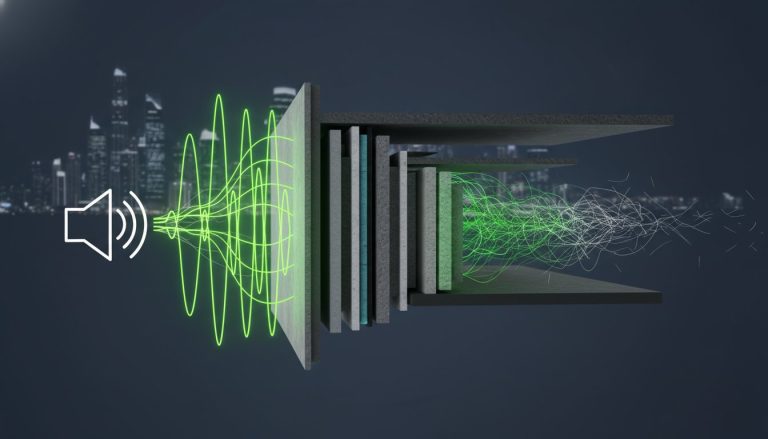
Flanking transmission occurs when sound bypasses the primary partition through adjacent building elements. Common paths in regional projects include continuous floor screeds that run under partitions and shared ceiling voids that lack proper acoustic barriers. Even a minor 2mm gap in acoustic sealant or a poorly fitted electrical socket box can lead to a 10 dB drop in performance. Structural connections that are not properly decoupled turn a well-designed wall or floor into an acoustic bridge, allowing vibration to travel across multiple floors.
Laboratory vs Field Discrepancies
It is vital to distinguish between laboratory sound reduction (Rw) and apparent on-site performance (R’w). Whilst a lab test suppresses all flanking paths to measure the partition in isolation, field results are typically 5 to 8 decibels lower than laboratory tests due to site-specific variables. We often compare these results against the Sound Transmission Class (STC) or the DnT,w (Weighted Standardised Level Difference), which accounts for the volume of the receiving room. Integrating architectural acoustics expertise early in the design process bridges this performance gap by accounting for site realities before the first stone is laid.
How to Organise On-Site Acoustic Testing: A Practical Process for Project Teams
Project teams often view on-site acoustic testing as a final box to tick before handover. This perspective introduces significant commercial risk. If a partition fails a sound insulation test after the carpets are laid and the joinery is fixed; the cost of remediation can increase by over 400 per cent compared to early-stage fixes. Organising on-site acoustic testing is not merely a technical requirement; it’s a strategic milestone that requires 12 weeks of forward planning to avoid project delays.
Selecting a representative sample of rooms is the first step. For large-scale residential projects in the UAE, regulatory bodies typically require testing on 10 per cent of each construction type. We prioritise "worst-case" scenarios, such as rooms with critical acoustic requirements, unique construction types, adjacent to lift shafts, plant rooms, or units with complex geometries. This approach ensures that if the most challenging areas pass, the rest of the floor plate likely complies. Many developers look to international standards like Approved Document E (ADE) as a benchmark for these procedures to ensure global quality standards are met within the local market. ADE is also quoted by Dubai Building Code as the required standard to adhere for residential buildings.
Timing is everything. You should book building acoustic testing to occur once the building envelope is sealed but before final decorative finishes are applied. This "grey box" stage allows for accessible remedial works if a failure occurs. Waiting until the snagging phase is a common error that leads to expensive redesigns and missed handover dates.
Site Preparation Requirements
Acoustic measurements are sensitive. For on-site acoustic testing to yield valid results, the site must be physically ready. All doors and windows in the area under test must be fitted, glazed, and fully operational with perimeter seals intact. Even a 2mm gap under a door can cause a 5dB drop in performance, leading to a false failure. Ideally, all mechanical services must be able to be switched off. We cannot measure the sound reduction of a wall if the HVAC system is creating high background noise levels that mask the source signal. Clear access and power provision to both the source and receiving rooms is essential; they shouldn’t be used for storage or as temporary site offices during the testing window.
Coordinating the Testing Schedule
Noise management is the biggest hurdle on a busy Dubai site. You cannot conduct sensitive measurements whilst other trades are drilling, screeding, or moving materials. We recommend integrating acoustic testing and verification into the main contractor’s schedule as a "quiet window," often during a night shift or a scheduled site shutdown. For critical areas like luxury hotel suites, a "dry run" or pre-completion test is invaluable when the mock-up rooms are constructed. It identifies flanking paths or installation errors early, providing the team with the confidence to proceed to final finishes without the threat of rework. If you’re managing a complex programme, speaking with a specialist early can help align these windows with your key milestones.
Navigating National Regulatory Compliance and International Standards
In the United Arab Emirates, acoustic compliance is a key component to obtain final sign-off on projects, and in some cases may hinder the process of achieving a Building Completion Certificate (BCC). Authorities such as Dubai Municipality and the Abu Dhabi Department of Municipalities and Transport enforce specific sound insulation targets to protect occupant well-being and ensure urban harmony. The ISO 16283 standard series serves as the global benchmark for field measurements, defining the rigorous procedures for airborne, impact, and facade sound insulation testing to ensure data accuracy across different building geometries. Without professional on-site acoustic testing, developers risk significant commercial and financial exposure during the final inspection phase. When disputes arise from these failures, engaging an acoustic expert witness UAE professionals trust can provide the forensic technical evidence needed to resolve conflicts and protect your commercial position.
Meeting National Standards
Legal building occupancy in the UAE depends on meeting noise limits that vary by sector. Residential separating walls typically require a minimum weighted standardised level difference (DnTw + Ctr) of 45 dB, whilst hospitality projects can be variable depending on operator brand standards, requirements of Dubai Department of Economy and Tourism (DET) and sustainability targets. Failure to provide certified verification reports to local authorities results in the withholding of building permits, which can cost developers thousands of AED in daily liquidated damages.
Effective coordination is essential for a successful handover. Adhering to the technical rigour found in ANC Sound Insulation Testing protocols ensures that the measurement equipment and technician competency meet international best practices. This level of precision is necessary when submitting documentation to authorities who require clear, defensible data to approve a project.
Achieving LEED, WELL and Estidama Credits
High-tier sustainability ratings like LEED v4.1, WELL and the Estidama Pearl Rating System offer credits for acoustic performance that go beyond baseline regulations. For a Pearl 2 or 3 rating in Abu Dhabi, developers must demonstrate that internal noise levels and sound transmission meet stringent thresholds. Achieving these credits requires more than just good intentions; it demands on-site acoustic testing results that are meticulously documented for submission to green building councils.
Early design alignment is the only way to meet these international benchmarks without incurring significant redesign costs. Many teams wait until the fit-out is finished to consider acoustics, only to find that the partition junctions or HVAC silencers don’t perform as expected. We simplify this by providing acoustic testing and verification throughout the construction cycle, ensuring that the final results align with the initial sustainability targets.
If you are approaching the final stages of construction and need to secure your building permit, contact our consultancy team to arrange for certified compliance testing.
Protecting Commercial Value Through Early Verification and Site Support
Acoustic performance is a critical asset in the UAE’s luxury real estate market. Remedial works in a completed high-rise development in Dubai can cost ten times more than the initial investment in expert advice. Whilst a design might look perfect on paper, the transition from CAD to the construction site often introduces unforeseen risks. As explored in our guide to construction support acoustics and why design reports often fail at handover, the gap between a theoretical model and a finished building is precisely where the most expensive errors occur. Professional on-site acoustic testing serves as a commercial safeguard, ensuring that the premium prices commanded by developers are justified by the actual living experience. In luxury developments, tenant turnover in buildings with poor sound insulation is 30% higher on average, directly impacting long-term yields.
Contractor errors are rarely isolated incidents. If a specific junction is installed incorrectly in a mock-up room, it will likely be replicated across hundreds of units. Early verification allows consultants to identify these systemic failures before they become embedded in the building’s structure. Our role is to simplify complex data into clear, actionable commercial decisions. We position construction support as a fundamental risk-mitigation strategy rather than an optional expense.
The Cost of Remedial Works
Failing a final acoustic test after a building is fully finished is a logistical nightmare. In luxury developments, stripping back bespoke joinery or high-end finishes to fix a flanking path can lead to costs exceeding AED 200,000 per affected area. Many contractors attempt "quick fixes" like expanding foam, poor quality sealants, cutting in extra layers of plasterboard etc. These methods rarely solve fundamental issues (structural or hidden inside partitions for example) and often fail to meet Dubai Municipality requirements. Identifying these performance risks during the mock-up stage provides a massive commercial advantage; it prevents delays that could jeopardise handover dates. In cases where disputes over acoustic performance escalate beyond the site, having access to a qualified acoustic expert witness in the UAE provides a defensible technical position in arbitration or legal proceedings.
Integrating Verification into the Build Phase
The acoustic consultant must supervise the installation of critical details, from resilient layers to service penetrations. Integrating construction support acoustics into the build cycle ensures that high-performance designs actually translate into functional, compliant spaces, rather than remaining confined to a project folder whilst the site team proceeds with the fit-out. Rigorous acoustic testing in the UAE protects developers from future litigation and tenant disputes. This proactive approach ensures that the "invisible" quality of a building matches its visible luxury. It creates a record of performance that builds trust with investors and end-users alike. Contact our team today to develop a project-specific verification strategy that secures your investment and guarantees compliance.
Securing Project Delivery Through Early Verification
Transitioning from a theoretical design to a high-performing building requires more than laboratory data. On-site acoustic testing is the only definitive way to bridge the reality gap and ensure your project meets stringent Middle East regulatory standards. By identifying installation defects or flanking paths early in the construction cycle, project teams avoid the significant financial risk of late-stage remedial works. These oversights often lead to costly delays during the handover phase, impacting the commercial viability of the development.
Focus Acoustics was established to provide independent, specialist consultancy across the UAE’s hospitality and large-scale residential sectors. We operate without ties to material manufacturers, ensuring our advice remains objective and focused on protecting your interests. Our experience across the region demonstrates that technical precision is a tool for confident decision-making, not a barrier to progress. Professional acoustic verification ensures that the quiet luxury promised in the design phase is actually delivered to the end-user. Taking control of the acoustic environment today prevents expensive complications tomorrow.
Contact Focus Acoustics to arrange your on-site verification strategy and ensure your building performs exactly as intended.
Frequently Asked Questions
What is the difference between Rw and DnT,w in acoustic testing?
Rw represents the laboratory-rated sound reduction index of a single component, whilst DnT,w measures the actual sound insulation performance between two rooms on-site. The DnT,w value accounts for flanking transmission and installation quality. Relying solely on Rw values often leads to a 5 to 8 dB performance gap compared to real-world results because lab conditions don’t account for site-specific construction defects.
When is the best time to conduct on-site acoustic testing during construction?
Conduct on-site acoustic testing once the building envelope is fully sealed and internal partitions are finished with doors and seals in place. Testing should occur before final decorative finishes are applied but after all mechanical services are installed. This timing allows for remedial works to be carried out without the 25% cost increase typically associated with post-completion retrofitting and avoids delays to the final handover schedule.
Do I need to test every room in my building for compliance?
You don’t need to test every room; instead, a representative sample of approximately 10% of each unit type is standard practice for residential and commercial developments. For projects in Dubai following Dubai Building Code requirements, the code specifically outlines the percentage of partitions that require verification (based on Approved Document E). We select the most at-risk rooms to ensure the most rigorous compliance check whilst managing project costs.
What happens if our building fails the on-site acoustic test?
If a test fails, we immediately conduct diagnostic investigations to identify the specific path of sound leakage, such as poorly sealed junctions or service penetrations. Failure to meet noise standards can delay the issuance of the Building Completion Certificate (BCC), leading to liquidated damages that often exceed 50,000 AED per day on large-scale developments. We provide a clear remediation strategy to rectify the issue with minimal impact on the remaining construction programme.
How long does a typical on-site acoustic measurement take to complete?
A typical set of airborne and impact sound insulation measurements for a standard apartment takes between 2 and 3 hours to complete. For multiple floors of a commercial office in DIFC, expect a team to be on-site for a full 8-hour shift to cover multiple partition types. This timeline assumes the site is clear of high-noise construction activities, as background noise levels must remain unaffected by constuction noise for the equipment to gather accurate, compliant data.
Can on-site testing help us achieve LEED or Estidama certification?
On-site testing is a fundamental requirement for achieving credits under the LEED Acoustic Performance category and the Estidama Indoor Environmental Quality section. For LEED v4.1, demonstrating compliance through on-site acoustic testing can secure up to 2 points toward your final certification level. These credits don’t just satisfy a regulatory checklist; they protect the asset’s long-term commercial value by guaranteeing a high-quality internal environment for premium tenants.