Even small exceedances in internal noise levels can cause real problems at handover. It doesn’t take much. A few decibels can mean delays, repeat testing, and last-minute remedial works when things don’t meet local authority requirements.
You’ll recognise how sensitive the final stages of a project are. Everything is tied together, and one technical miss can quickly turn into programme pressure and exposure to liquidated damages.
This article breaks down how to manage acoustic testing in Dubai properly. Not theory, but what actually matters. What the approval process looks like, where projects typically go wrong, and how to make sure your design intent holds up when it’s built.
The shift is simple. Stop treating testing as a tick-box at the end. Get it right upfront, and you avoid the scramble, the retrofit costs, and the risk at handover.
Key Takeaways
- Acoustic issues picked up at testing stage can hold up completion approvals and delay handover. That’s real programme and revenue risk.
- Lab ratings don’t mean much if the build quality doesn’t match. Good products get let down by poor coordination all the time.
- You need to understand what’s actually being tested on site. Airborne and impact performance are the ones that will catch you out in residential.
- A simple sample testing strategy before completion can expose repeat issues early, when they’re still fixable without blowing the budget.
- Testing data is only useful if you act on it. The value is in turning results into clear decisions that protect the design intent and avoid problems at handover.
Table of Contents
The Real Cost of Failed Acoustic Verification at Handover
The final weeks of a project are all about getting to completion. But this is exactly where things can come unstuck if acoustic testing hasn’t been properly planned.
Testing isn’t a formality at the end. It’s the point where the building proves it actually performs as designed. If it doesn’t meet Dubai Municipality requirements or project criteria, you’re into delays, repeat testing, and unplanned remedial works at the worst possible time.
That has a direct commercial impact. Handover slips, revenue gets pushed, and you’re dealing with issues when everyone is already under pressure to close out the job.
Acoustic testing is there to protect you, not catch you out. It gives you confidence that what’s been designed has actually been delivered on site. Without that, you’re relying on assumption.
In residential and hospitality projects, this matters more than most. If the space doesn’t perform acoustically, it’s not a minor defect. It undermines the product.
Why Handover Delays are a Critical Risk
Handover delays aren’t just inconvenient. They hit the bottom line. Most contracts in Dubai carry liquidated damages, and once you slip, the exposure adds up quickly.
Acoustic issues are a common late-stage blocker because they only show up when you test. If performance doesn’t meet the target, you don’t move forward. Simple as that.
The problem is timing. By the time you’re testing, the building is finished. Walls are closed, MEP is live, finishes are in. If something’s wrong, you’re not tweaking a detail. You’re opening up completed work to find the issue.
And acoustics doesn’t fail in obvious ways. Sound takes the weakest path, not the most visible one. in architectural acoustics that could be a junction, a service penetration, or something buried behind multiple layers of construction. Finding it at that stage is slow and expensive.
This is where most projects lose control. Not because the design was wrong, but because verification came too late.
Get acoustic testing and verification in earlier, and you avoid turning a technical issue into a commercial problem.
The Hidden Expense of Late-Stage Redesign
There’s a common assumption that acoustic issues can be fixed later. In reality, that’s where projects get hurt the most.
Once finishes are in, any fix becomes disruptive. You’re not adjusting a detail on paper, you’re pulling apart completed work. Partitions, ceilings, façades, all tied into other trades that now need to be revisited.
The cost isn’t just the fix itself. It’s the knock-on impact
-
High-end finishes often need to be stripped out and replaced, sometimes more than once
-
Glazing changes at late stage can become a full logistics exercise with access, lifting, and sequencing issues
-
Multiple trades get dragged back in, creating programme clashes and inefficiencies
By that point, you’re solving a problem in the most expensive way possible.
Early input from an acoustic consultant is a fraction of that risk. It’s not about adding cost, it’s about avoiding it.
"Fix it later" sounds convenient, but it ignores how sound behaves and how buildings are actually put together. By the time you’re close to handover, your options are limited and expensive.
Get the decisions right early, and you don’t end up paying for the same work twice.. When disputes do arise from late-stage acoustic failures, having access to an acoustic expert witness UAE can provide the forensic technical evidence needed to protect your commercial position.
Why Compliant Materials Fail On-Site Acoustic Tests
It’s a common scenario. A developer invests in high-performance drywall systems or premium glazing, backed by strong lab ratings. On paper, everything looks compliant. Then site testing comes back well below target.
That gap isn’t minor. A drop of 10–15 dB is not unusual in poorly coordinated builds, and that level of difference is clearly noticeable to the end user. At that point, it’s no longer a technical issue. It’s a product failure.
The root cause is simple. Materials don’t fail. Systems do.
The Lab vs. Site Reality Gap
Laboratory ratings are achieved under controlled conditions. Junctions are perfectly sealed, construction is idealised, and flanking paths are eliminated.
That’s not how buildings are put together on site.
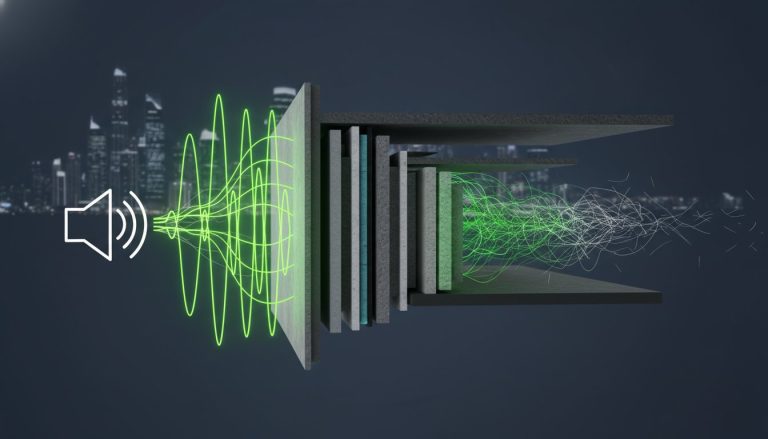
In reality, sound doesn’t just pass through a wall. It finds the weakest path around it. Through floor slabs, façade interfaces, ceiling voids, and service penetrations. This is flanking transmission, and it’s the main reason performance drops between lab and site.
Even on a well-executed project with solid construction support, some reduction is expected. But where detailing, coordination, and supervision are lacking, that drop becomes significant enough to fail testing.
Understanding this difference is critical. A lab rating is a reference point, not a guarantee of performance in your building.
Workmanship and the ‘Last Mile’ of Performance
Acoustic performance relies heavily on how well the design is executed on site. This is where most projects fall short.
The "last mile" of installation is often rushed, and small details get overlooked. Those small details are exactly what control acoustic performance.
Typical failure points we see during inspections:
-
Back-to-back electrical sockets within the same stud cavity, creating a direct weak point through the partition
-
Unsealed or poorly sealed junctions at floor, soffit, or façade interfaces
-
Rigid connections of ducts, pipes, or containment transferring vibration directly through the structure
Individually, these issues seem minor. Combined, they significantly reduce the effectiveness of an otherwise well-designed system.
By the time testing highlights these problems, the building is already finished. Fixing them means opening up completed work, disrupting multiple trades, and absorbing the cost and programme impact.
The Real Issue
There’s a false sense of security in product submittals.
A datasheet shows what a material achieved once, in a controlled environment. It does not reflect how that material will perform as part of a full building system.
Treating submittals as proof of compliance is where projects take on unnecessary risk. What matters is how the system is detailed, installed, and verified on site.
If you want to avoid failures at handover, verification needs to happen earlier. Mock-ups, sample testing, and site inspections during installation are far more effective than relying on final testing to confirm everything is working.
Catch the issues early, and they’re easy to fix. Leave it to the end, and you’re dealing with cost, delay, and avoidable risk.
Essential Acoustic Tests for UAE Building Regulations
Failing a final inspection due to poor sound insulation can delay handover and trigger unplanned rework. This isn’t theoretical. Acoustic performance is a compliance gate, and if it doesn’t meet the required criteria, the project doesn’t progress.
Testing is what proves the building actually performs as designed. Without it, you’re relying on assumption.
There are four core test types that typically determine whether a project clears this stage:
- Airborne Sound Insulation
Tests to ISO 16283-1 verify that noise between adjacent units is controlled. This is critical in residential and hospitality where privacy is expected.
- Impact Sound Insulation
Measures how well floor constructions deal with footfall and movement. This is one of the most common sources of complaints in multi-storey buildings.
- Ambient Noise Levels (NC/NR)
Assesses background noise from MEP systems. If this is too high, the space becomes uncomfortable immediately after occupation.
- Reverberation Time (RT60)
Relevant for larger or shared spaces. Controls how sound behaves within the room and directly affects usability and perceived quality.
These tests aren’t independent checks. Together, they define whether the building is commercially viable from an acoustic perspective.
Regulatory Frameworks in the Middle East
Meeting Dubai Municipality requirements isn’t just about selecting high-spec materials. It’s about coordination across disciplines.
Fire and life safety requirements, façade systems, and MEP design all influence acoustic performance. In many cases, these requirements pull in different directions, and without proper alignment, something gives.
For projects targeting LEED or Estidama, the bar is higher. These frameworks require measurable performance, not just design intent. That means on-site verification becomes essential, not optional.
The challenge isn’t understanding the standards. It’s making sure the design actually translates into something that meets them when built. Construction support acoustics is the essential bridge between a compliant design report and a building that actually passes its final inspection.
Verifying Building Services and MEP Noise
A large proportion of post-handover complaints relate to building services noise.
The issue is rarely the equipment itself. It’s how it’s installed.
Poor vibration isolation, incorrectly installed attenuators, or rigid connections into the structure can transfer noise well beyond what was predicted at design stage.
Testing at plant rooms and key distribution areas allows these issues to be identified early. At that point, they’re usually straightforward to resolve.
Leave it until after ceilings are closed and spaces are occupied, and the same issue becomes far more disruptive and expensive to fix. Where MEP noise disputes escalate beyond the project team, engaging a qualified acoustic expert witness in the UAE can provide the independent technical assessment needed to resolve liability questions efficiently.
Managing the Testing Program to Protect Your Budget
Treating acoustic testing as a final hurdle is where most projects take on unnecessary risk.
If testing only happens at the end, any failure becomes a programme issue. There’s no buffer, no flexibility, and no easy fix.
By that stage, even minor issues can trigger disproportionate cost and delay because of the level of completion.
A better approach is to build testing into the programme. Not as an afterthought, but as part of the quality control process.
The Case for Pre-Completion Testing
Early sample testing is one of the simplest ways to reduce risk.
Test a typical room or unit while the works are still ongoing, and you get a clear view of how the system is actually performing.
If there’s a problem, you fix the method, not the finished product.
That could be a detailing issue, a sequencing problem, or a coordination gap between trades. All of these are manageable early on.
Left until the end, the same issue becomes a strip-out and rebuild exercise.
Early testing doesn’t add complexity. It removes uncertainty.
Site Readiness Checklist for Verification
For acoustic testing to be valid, the site needs to be properly prepared. If it’s not, results are unreliable and tests need to be repeated.
At a minimum:
-
Building envelope complete and sealed
-
Internal doors installed and operational
-
MEP systems commissioned for ambient noise testing
-
Power available for test equipment
-
No active construction noise in the testing zone
This requires coordination. Testing doesn’t sit in isolation. It needs to be planned alongside other site activities.
Getting this right avoids wasted time, repeat visits, and unnecessary friction between teams.
Closing the Gap Between Design Intent and Built Reality
This is where most projects struggle.
The design may be sound, but execution varies. Small gaps, substitutions, or coordination issues all add up.
If those issues aren’t picked up early, they surface at the worst possible time.
Testing is what closes that gap. It turns design assumptions into measurable performance.
The value isn’t just compliance. It’s certainty.
Professional Certification and Asset Value
In high-end developments, performance isn’t assumed. It’s expected to be demonstrated.
A clear, independent verification report gives confidence to investors, operators, and tenants. It shows that the building performs as intended.
It also provides protection in the event of disputes. When issues arise, having measured data removes ambiguity and avoids the typical back-and-forth between parties.
Next Steps for Project Teams
Leaving testing to the final week is a risk most projects don’t need to take.
A more controlled approach would be:
-
Introduce sample testing once typical areas are constructed
-
Include acoustic checkpoints within contractor QA processes
-
Review critical details before they’re closed up
None of this is complicated. It just needs to be planned.
Securing Handover and Long-Term Asset Value
Handover shouldn’t be where problems are discovered.
If acoustic performance has been considered, checked, and verified throughout the build, the final testing becomes confirmation rather than a risk.
The difference is approach. Reactive vs proactive.
Get it right early, and you avoid delays, rework, and uncertainty at the point where the project should be closing out.
Frequently Asked Questions
How much does acoustic testing typically cost in Dubai?
Costs depend on the size of the project, number of test locations, and scope of testing required. Smaller residential packages are relatively straightforward, while high-rise or mixed-use developments with multiple test types and MEP checks will scale accordingly. Acoustic testing is a controlled cost, whereas late-stage remedial works are not.
What happens if we fail the initial acoustic test?
The issue must be identified, rectified, and retested before approvals can proceed. This often leads to delays, particularly if testing is carried out at the end of the programme with no buffer. Early testing reduces this risk significantly.
Is acoustic testing mandatory for projects in Dubai?
Most residential developments and many commercial projects are expected to demonstrate compliance with acoustic performance criteria as part of the approval process. The exact requirements depend on the authority and project type, so it should always be confirmed early in the design stage.
Why do buildings fail acoustic tests even with compliant materials?
Acoustic performance depends on the full system, not just the material. Common causes of failure include flanking paths, poor sealing at junctions, and coordination issues between trades. A compliant product does not guarantee compliant performance on site.
What is the difference between lab ratings and on-site results?
Laboratory ratings reflect performance under controlled conditions. On-site results account for real construction variables, including flanking transmission and installation quality. Some reduction is expected, but poor coordination can lead to significant performance gaps.
How long does acoustic testing take on a high-rise project?
Testing typically takes several days depending on the number of units, spaces, and systems being assessed. Site readiness plays a major role. If conditions are not suitable, testing may need to be delayed or repeated.
Can acoustic issues be fixed after handover?
Yes, but it is significantly more disruptive and expensive. Access is limited, finishes are complete, and occupants may already be in place. Resolving issues during construction is far more efficient.
What are the most common causes of acoustic test failure?
Typical issues include unsealed junctions, back-to-back services within partitions, and rigid connections transferring vibration. These are often installation-related rather than design-related.
When should acoustic testing be introduced into the programme?
Testing should be introduced during construction through sample or mock-up testing, not left to the final stage. This allows issues to be identified and corrected before they are repeated across the project.
Does acoustic testing only apply to residential projects?
No. While residential projects often have strict sound insulation requirements, commercial, hospitality, and mixed-use developments also have acoustic performance expectations that affect occupant comfort and usability.