In construction projects, acoustics is sometimes treated as an unusually flexible discipline. There is a common assumption that noise problems can be addressed later in the project, adjusted during commissioning, or resolved through minor changes once construction is complete.
In reality, acoustic performance is governed by physical principles that are no more negotiable than those controlling structure, fire safety, or mechanical systems.
Sound transmission within buildings follows measurable laws of physics. Once the physical conditions influencing sound have been established in a design, they cannot simply be improvised away later.
For this reason, acoustic design should be considered alongside other core engineering disciplines from the earliest stages of project development.
The Physical Principles Behind Building Acoustics
Across the built environment, every engineering discipline depends on fundamental physical constraints.
Fire strategies rely on protected escape routes, tested fire-rated assemblies, and defined safety distances.
Structural systems depend on mass, geometry, and load paths that must remain intact for the building to perform safely.
Mechanical, electrical, and plumbing (MEP) systems require sufficient space allocation, service routes, and access for maintenance.
Acoustics operates within the same framework of physical requirements.
Effective building acoustics and environmental noise control depend on several key factors:
-
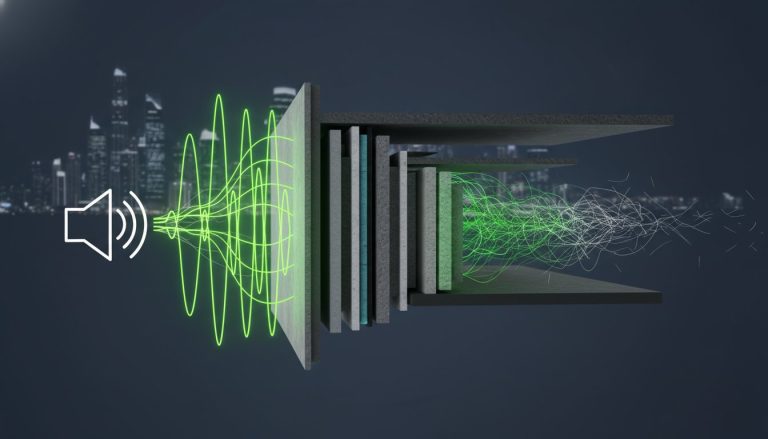
Mass to reduce airborne sound transmission
-
Separation between noise sources and sensitive spaces
-
Continuity of acoustic barriers and building elements
-
Geometry that influences sound reflection and propagation
Without these conditions in place, achieving the desired acoustic performance becomes significantly more challenging.
Why Acoustic Issues Often Appear Late in Projects
When acoustic problems emerge near the end of construction or after building occupation, the issue is rarely a lack of available technical solutions.
More often, it is because the physical conditions required for effective sound control were not preserved during design coordination.
Examples include:
-
partitions that lack sufficient mass for sound insulation
-
façade systems that do not adequately control environmental noise
-
mechanical equipment located too close to sensitive spaces
-
discontinuities in acoustic barriers caused by service penetrations
Once these physical constraints have been compromised, later interventions can only partially mitigate the issue.
This is why early coordination with an acoustic consultant in Dubai or the wider GCC region is essential for complex developments.
The Growing Importance of Acoustic Consultancy in the Middle East
Across the UAE and the wider Middle East, urban development has increased both the density and complexity of buildings. High-rise residential towers, luxury hospitality projects, mixed-use districts, and large-scale masterplans all place greater demands on acoustic performance.
Professional acoustic consultancy services help project teams anticipate sound-related challenges before they affect building occupants.
Typical services within the region include:
-
environmental noise assessments and sound propagation modelling
-
façade acoustic design for developments exposed to urban noise
-
building services noise and vibration control
-
sound insulation strategies for residential and hospitality projects
-
room acoustic design for commercial and public spaces
At Focus Acoustics, acoustic consultancy across the UAE and GCC focuses on integrating sound control into the broader building design process.
This approach helps ensure that developments deliver not only architectural impact but also the everyday comfort expected from modern buildings.
Engineering Discipline, Not Interpretation
The most successful acoustic outcomes occur when sound control is treated as a fundamental engineering parameter rather than a flexible design element.
Just as structural performance cannot be recovered once load paths are removed, acoustic performance cannot be fully restored once the physical conditions that control sound transmission are compromised.
Acoustics does not fail because it is mysterious.
It fails when it is treated as negotiable.
When approached as an engineering discipline grounded in physics, acoustics becomes a predictable and powerful tool for improving building performance across the built environment.