Reducing Cross-Talk in Corporate Meeting Rooms: A Practical Guide to Speech Privacy
Most meeting rooms fail at the one thing they are supposed to do.
Confidential discussions are overheard. Conversations leak into adjacent spaces. What was designed as a private room becomes a risk.
This is not a product problem. It is a coordination problem.
Reducing cross-talk in corporate meeting rooms is not about specifying a higher-rated wall. It is about understanding how sound actually travels through a built environment.
This guide explains where speech privacy breaks down, what needs to be addressed at each stage of a project, and how to avoid expensive rework once the fit-out is complete.
Key Takeaways
- Speech privacy failures are usually caused by flanking paths, not the partition itself.
- Ceiling plenums and ductwork are the most common routes for sound leakage.
- Laboratory ratings do not reflect real-world performance.
- Late-stage fixes are expensive and disruptive.
- Early coordination across architecture and MEP is essential.
The Commercial Risk of Cross-Talk
In corporate environments across Dubai and Riyadh, speech privacy is not optional.
Meeting rooms are used for:
- Commercial negotiations
- HR discussions
- Legal conversations
- Confidential client interactions
If speech is intelligible outside the room, the space is not functioning as intended.
This creates:
- Reputational risk
- Operational disruption
- Potential legal exposure
These issues typically only become visible after occupation, when it is already too late.
Why Standard Partitions Fail
Most teams assume that a high-performance wall will solve the problem.
It will not.
Laboratory ratings such as STC are measured in controlled conditions. They do not account for:
- Gaps in construction
- Flanking paths
- MEP penetrations
- Ceiling void conditions
In practice, site performance is often significantly lower than expected.
This is where architectural acoustics input is required to bridge the gap between specification and reality.
How Sound Bypasses the Wall
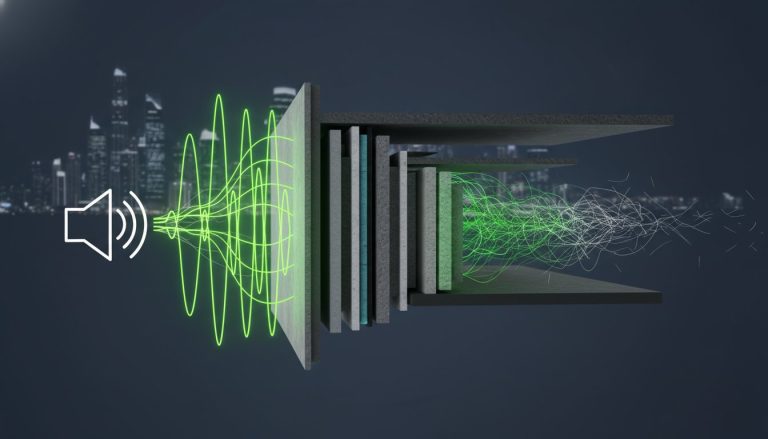
Sound follows the path of least resistance.
If it cannot pass through the wall, it will go around it.
Ceiling Plenum
This is the most common failure point.
Partitions often stop at the ceiling grid, leaving a shared void above. Sound reflects within this space and enters adjacent rooms.
Ceiling tiles do not provide sufficient sound insulation. They are designed for absorption, not separation.
HVAC Ductwork
Shared ducts can act as direct transmission paths between rooms.
This is a common issue where meeting rooms share short duct runs without attenuation.
Proper coordination with building services noise and vibration is required to control this.
Junctions and Penetrations
Even small gaps can significantly reduce performance.
Typical issues include:
- Unsealed partition heads
- Back-to-back sockets
- Service penetrations
These are often missed during construction.
What This Looks Like on a Real Project
A typical scenario:
A corporate office installs high-spec partitions for executive meeting rooms. The wall build-up meets design requirements.
After occupation, users report that conversations can be heard in adjacent rooms.
Investigation identifies:
- Open ceiling plenum
- Shared ductwork without attenuation
- Gaps at partition head
The wall is not the issue. The system is.
Fixing this after completion requires opening ceilings, modifying services, and reworking interfaces.
This is avoidable with early coordination.
What To Do at Each Stage
Concept Stage
- Define speech privacy requirements
- Identify high-risk room adjacencies
Design Stage
- Develop partition strategies
- Coordinate ceiling and MEP systems
- Address flanking paths
Construction Stage
- Inspect installation quality
- Ensure sealing is complete
Pre-Handover
- Carry out acoustic testing and verification
- Identify issues before occupation
Early input from specialist acoustic advisory reduces risk across all stages.
Testing, Handover, and Risk
Testing confirms performance. It does not fix problems.
If speech privacy fails at this stage:
- Remedial works are required
- Programme is impacted
- Costs increase
Where issues arise late, construction support and DLP close-out can help manage resolution.
Final Thought
Meeting rooms are built for conversations.
If those conversations are not contained, the room has failed.
The solution is not a better wall. It is better coordination.