Recent reports across the UAE have described residents hearing sudden loud “booms” in the sky. A recent article published by The National provides a clear explanation of the physical mechanisms behind these sounds and offers useful reassurance from a technical standpoint.
From an acoustic perspective, the phenomenon is relatively well understood.
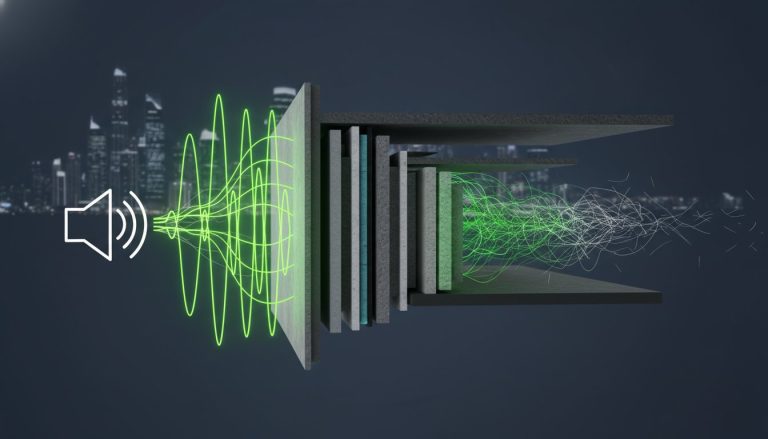
When objects travel at extremely high speeds through the atmosphere, particularly at or above the speed of sound, they generate pressure waves that propagate outward through the air. When these waves reach the ground, they may be perceived as a sharp sonic boom.
In certain cases, these events originate many kilometres above the Earth’s surface. Atmospheric conditions such as temperature gradients, wind layers, and air density can influence how these acoustic shock waves travel, allowing them to be heard far from their original source.
For specialists working in environmental acoustics and sound propagation modelling, this behaviour illustrates how sound can travel through complex atmospheric systems over very large distances.
Sound Physics Versus Human Perception
While the scientific explanation for these sounds is well established, the way people interpret them is often very different.
Human perception of sound is shaped not only by measurable acoustic properties such as sound pressure level, frequency content, and duration, but also by psychological context and expectation.
A sudden, unfamiliar boom can trigger strong reactions because our brains instinctively associate certain acoustic signatures with significant events or potential danger. Even when the physical cause is later explained, the immediate interpretation often reflects the meaning we attach to the sound rather than the underlying physics.
Understanding this relationship between acoustic measurement and human perception is a key part of environmental acoustics.
Why Sound Propagation Matters
Events such as these highlight an important principle in acoustic science: sound does not always behave in intuitive ways.
Across urban environments, coastlines, and large infrastructure developments, sound can travel significant distances depending on atmospheric conditions and surrounding geometry.
In professional practice, acoustic consultants regularly analyse these effects using sound propagation modelling and environmental noise assessments.
Across the UAE and wider Middle East, acoustic consultancy services commonly involve evaluating sound from sources such as:
-
aircraft and aviation activity
-
infrastructure and transportation systems
-
construction and industrial operations
-
environmental noise affecting residential developments
Understanding how sound behaves in real-world environments allows engineers to predict potential impacts and design mitigation strategies where necessary.
The Role of Environmental Acoustics in the Middle East
As cities across the UAE continue to expand and infrastructure becomes more complex, the role of environmental acoustics is becoming increasingly important.
Specialist acoustic consultants help developers, planners, and engineers understand how sound interacts with buildings, landscapes, and atmospheric conditions. This includes work such as:
-
environmental noise impact assessments
-
sound propagation modelling for major developments
-
façade acoustic design to manage external noise exposure
-
building services noise control within complex buildings
At Focus Acoustics, environmental acoustics forms part of a broader approach to building performance and urban development across the Middle East.
Sound as Both Science and Experience
Acoustics sits at an interesting intersection between engineering and human perception.
While the physical behaviour of sound can be explained through well-established scientific principles, the way people experience and interpret sound depends on many additional factors, including context, expectation, and familiarity.
Understanding both sides of this equation allows acoustic consultants to provide technical insight while also supporting environments that feel comfortable and predictable for the people who use them.
In rapidly evolving urban environments such as the UAE, this balance between scientific analysis and human perception of sound will remain an important part of responsible development.