Facade Acoustics in Dubai: A Practical Guide to Designing High-Performance Building Envelopes
In Dubai, your façade is not just part of the architecture. It is your primary acoustic barrier.
On sites exposed to major roads, metro lines, or dense urban activity, external noise levels regularly exceed 75 to 85 dB. Without a properly designed façade, that noise transfers directly into internal spaces.
This is where many projects fail. Not because the design team lacks capability, but because façade acoustics is treated as a late-stage specification instead of an early-stage strategy.
Facade acoustics Dubai is not just about glazing. It is about coordination between architecture, structure, façade engineering, and MEP systems.
This guide sets out how to approach façade acoustic design properly. It focuses on what actually drives performance, where projects go wrong, and how to reduce risk before it becomes a problem on site.
Key Takeaways
- The façade is the primary control layer for external noise.
- Glazing performance alone does not define success. Interfaces and detailing do.
- Most failures occur due to flanking paths and installation issues.
- Late-stage fixes are expensive and disruptive.
- Early coordination reduces both cost and programme risk.
Why Facade Acoustics Matters in Dubai
In dense urban developments, the façade defines internal acoustic performance.
If it underperforms, the impact is immediate:
- Residential units fail comfort expectations
- Hotels receive noise complaints and poor reviews
- Office environments lose productivity
- Projects struggle to meet compliance requirements
These are not theoretical risks. They are common outcomes on projects where façade acoustics has not been properly addressed.
In most cases, the issue is not visible during design. It only becomes clear at testing stage or after occupation. By then, options are limited.
This is why façade performance should be defined early through environmental noise planning, not left to be resolved at the end.
Understanding the External Noise Environment
Before defining façade performance, the external noise environment needs to be understood properly.
In Dubai, this typically includes a combination of:
Road Traffic Noise
Continuous broadband noise with significant low-frequency content. This is often the dominant source on urban sites.
Rail and Metro Systems
Intermittent but high-impact noise events. These can be particularly disruptive if not considered in façade design.
Urban Activity
Construction, events, and mixed-use developments create variable noise conditions throughout the day and night.
Without proper assessment, façade design becomes guesswork. Performance requirements need to be based on measured or modelled data, not assumptions.
Core Principles of Facade Acoustic Design
1. System Performance, Not Just Products
A façade is a system. Its performance depends on how all elements work together.
Focusing on a single component, such as glazing thickness, is not enough. Interfaces, fixings, and penetrations all influence performance.
2. Glazing Strategy
Glazing is typically the weakest element acoustically.
Effective strategies include:
- Laminated glass with acoustic interlayers
- Asymmetric glass thickness to reduce resonance
- Optimised air cavity depths
Standard double glazing is often insufficient for high-noise environments.
3. Airtightness
Air leakage is one of the biggest acoustic risks.
Typical issues include:
- Gaps at frame interfaces
- Poor gasket installation
- Unsealed joints
If air can pass through, sound can pass through. Even small gaps can significantly reduce performance.
4. Flanking Transmission
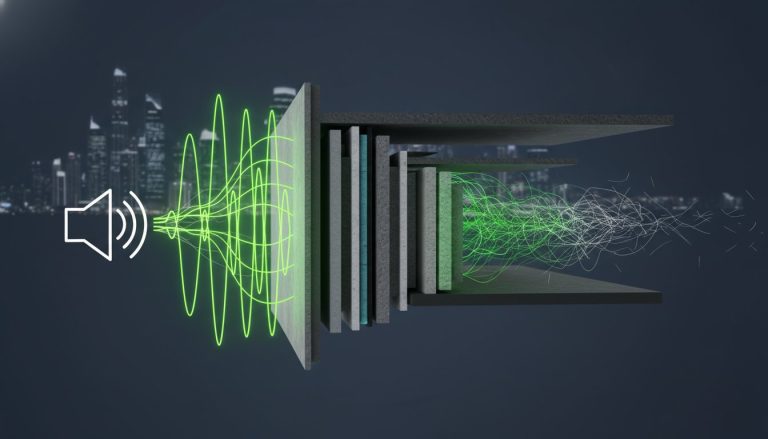
Sound does not only pass through the façade. It travels around it.
Common flanking paths include:
- Slab edges
- Curtain wall interfaces
- Ceiling voids
- Service penetrations
This is where coordination with architectural acoustics becomes critical.
5. Ventilation and MEP Interfaces
Ventilation openings, louvres, and façade penetrations are often acoustic weak points.
Balancing airflow and acoustic performance requires coordination with building services noise and vibration.
Where Projects Fail
Most façade acoustic failures follow the same pattern.
Typical issues include:
- Glazing selected without acoustic assessment
- Façade and MEP systems designed in isolation
- Uncontrolled penetrations and vents
- Value engineering removing key elements
- Poor installation quality on site
These problems usually only become visible during testing or after occupation.
At that point, the cost of fixing them is significantly higher. Working with an acoustic consultant in Dubai from the outset is the most effective way to prevent these failures before they occur.
What This Looks Like on a Real Project
A typical scenario:
A residential tower located near a major road is designed with standard double glazing. The façade appears compliant based on assumptions.
During testing, internal noise levels exceed acceptable limits.
Investigation identifies multiple issues:
- Glazing performance is insufficient for the noise environment
- Flanking paths exist at slab edges
- Ventilation openings bypass the façade system
At this stage, options are limited. Solutions may involve replacing glazing, modifying interfaces, or introducing secondary systems.
All of these are costly and disruptive.
This is a common scenario. It is also avoidable.
What To Do at Each Stage of a Project
Concept Stage
- Assess external noise conditions
- Define internal performance targets
- Identify high-risk façades
Design Development
- Develop façade performance specifications
- Coordinate glazing, structure, and MEP systems
- Detail interfaces and penetrations
Proper specification requires understanding how different acoustic materials UAE perform in practice, not just in laboratory conditions. Internal acoustic performance is equally important at this stage — a precise reverberation time calculation early in design development ensures that finish schedules and interior specifications support the acoustic environment, not undermine it.
Construction Stage
- Monitor installation quality
- Ensure airtightness is achieved
- Check critical details on site
Pre-Handover
- Prepare for acoustic testing and verification
- Identify potential risks before testing
Early input from specialist acoustic advisory reduces risk at every stage.
Testing, Compliance, and Risk
Acoustic testing confirms whether the façade performs as intended.
It does not create performance.
If the façade fails testing:
- Completion may be delayed
- Rectification becomes intrusive
- Costs increase significantly
Where issues arise late, construction support and DLP close-out can help manage resolution.
But this is reactive. The objective should always be to prevent failure.
Frequently Asked Questions
Why is façade acoustics critical in Dubai?
External noise levels are high. Without proper design, internal environments are compromised.
What are the biggest risks?
Flanking paths, poor sealing, glazing underperformance, and lack of coordination.
Can problems be fixed later?
Yes, but at significantly higher cost and disruption.
What performance should be targeted?
Typically 30–40 dB internally for residential and hospitality environments. Understanding the full scope of what a specialist brings to a project is covered in detail in this commercial guide to hiring an acoustic consultant in Dubai.
Final Thought
The façade is your first acoustic decision.
If it is wrong, everything behind it is affected.
Get it right early, and the rest of the project becomes easier.