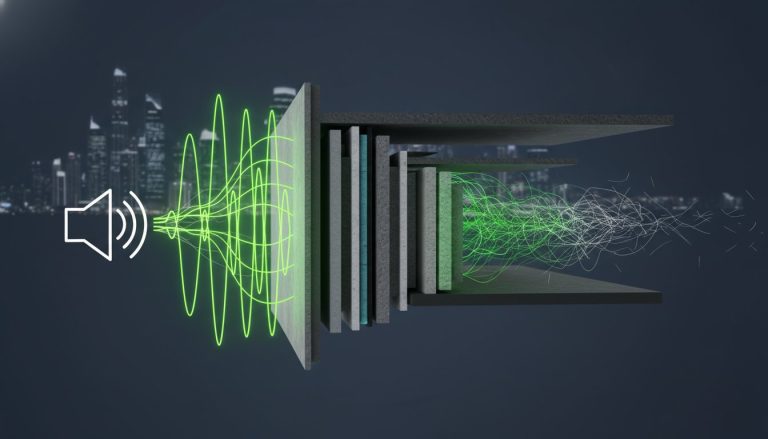
Designing Quiet Plant Rooms in Saudi Arabian Megaprojects: A Practical Guide to Noise and Vibration Control
Plant rooms do not fail quietly.
When acoustic issues arise, they are usually discovered late. During testing. Or after occupation. By that point, the problem is no longer design. It is cost, delay, and disruption.
In Saudi Arabian megaprojects, plant room acoustics is a critical design risk that directly affects building performance.
This guide focuses on what actually matters. Where projects go wrong, how noise and vibration move through buildings, and what needs to be done at each stage to avoid failure.
Key Takeaways
-
Plant room noise issues are typically caused by vibration, not just airborne sound.
-
Structure-borne transmission is the most common failure mechanism.
-
Most problems come from coordination gaps, not equipment selection.
-
Late-stage fixes are expensive and disruptive.
-
Early acoustic input reduces risk across design and construction.
Why Plant Room Acoustics Matters in Saudi Projects
This is why plant room acoustics in Saudi Arabia needs to be considered as part of core building performance, not a late-stage adjustment.
Mechanical systems in Saudi developments operate at high capacity for most of the year.
This creates:
-
Continuous background noise
-
Low-frequency vibration
-
Structure-borne transmission through the building frame
If not controlled properly, these effects extend far beyond the plant room.
Common outcomes include:
-
Noise in residential units
-
Disturbance in hotel rooms
-
Complaints in office environments
These issues often appear several floors away from the source.
This is why early coordination through building services noise and vibration is critical.
Understanding Noise Paths
Airborne Noise
Airborne noise is generated directly by equipment such as:
-
Chillers
-
Air handling units
-
Pumps and fans
This type of noise travels through:
-
Openings
-
Ductwork
-
Weak points in construction
It can be controlled with:
-
Mass
-
Airtightness
-
Acoustic lining
Structure-Borne Noise
This is the bigger risk.
Vibration from equipment enters the building structure and travels through slabs, columns, and beams.
This can result in:
-
Noise appearing far from the source
-
Low-frequency hum in occupied spaces
-
Difficult-to-diagnose complaints
Once this happens, solutions become complex.
Where Projects Fail
Plant room acoustic failures follow predictable patterns. These failures are common across plant room acoustics in Saudi Arabia where coordination between disciplines breaks down.
Typical issues include:
-
Incorrect vibration isolation selection
-
Rigid connections bypassing isolators
-
Uncontrolled service penetrations
-
Façade or structure acting as a flanking path
-
Lack of coordination between disciplines
These problems usually originate during design but only become visible later.
What This Looks Like on a Real Project
A typical scenario:
A high-rise development installs large chillers on an upper-level plant floor.
During commissioning, a low-frequency hum is detected in premium residential units below.
Investigation identifies:
-
Vibration bypassing isolators through pipe supports
-
Rigid connections transmitting energy into the slab
-
Insufficient isolation for equipment load
Fixing this requires:
-
Replacing isolators
-
Modifying supports
-
Opening finished areas
This is expensive and disruptive.
It is also avoidable.
Similar cost exposure is well documented in high-rise residential developments across the Gulf region. Plumbing noise control in Qatar presents comparable remedial cost risks when acoustic performance is not addressed before finishes are applied and ceilings are closed.
What To Do at Each Stage
Concept Stage
-
Locate plant rooms away from sensitive spaces
-
Identify high-risk adjacencies
Design Stage
-
Select appropriate vibration isolation systems
-
Coordinate MEP and structural design
-
Control airborne and structure-borne paths
Ductwork is a common transmission path that is frequently underestimated at this stage. Accurate duct noise calculation during design helps prevent airborne noise from propagating through the distribution system into occupied spaces.
Construction Stage
-
Check installation of isolators
-
Avoid rigid connections
-
Verify sealing and detailing
For MEP teams working on similar challenges in the region, implementing a comprehensive vibration isolation Dubai checklist can help prevent costly retrofits and ensure proper installation from the outset.
Pre-Handover
-
Undertake acoustic testing and verification
-
Identify issues before occupation
Early input from specialist acoustic advisory reduces risk across all stages.
Testing, Compliance, and Risk
Testing confirms whether the plant room performs as intended.
It does not fix problems.
If performance is not achieved:
-
Handover may be delayed
-
Remedial works are required
-
Costs increase
Where issues arise late, construction support and DLP close-out can help manage resolution.
Final Thought
Getting plant room acoustics in Saudi Arabia right early reduces risk across design, construction, and operation.
Plant room acoustics is not about making equipment quieter.
It is about preventing that energy from entering the building.
If that is controlled early, the rest of the project becomes easier.