A single rooftop chiller on a commercial tower can generate sound levels reaching 92 decibels, which often leads to immediate non-compliance notices from building authorities and frustrated tenants. You’ve likely felt the tension when a high-performance cooling system, which is essential for the UAE climate, becomes an intrusive source of vibration that devalues a premium property. It’s a common struggle to find the balance between powerful air exchange and the quietude expected in a luxury development.
Beyond the initial engineering design, the physical condition of the mechanical components plays a significant role in their acoustic output. To ensure your system operates without unnecessary mechanical strain or air turbulence, you can find out more about AC Deep Cleaning as a proactive measure to support a quieter and more efficient indoor environment.
This article demonstrates how specialized hvac noise control dubai and engineering precision eliminate mechanical disturbances to create truly tranquil indoor environments across the Emirates. You’ll discover how to integrate acoustic solutions into MEP designs to avoid the 35% cost premium often associated with emergency retrofits in premium developments. We will examine the technical selection of silencers and vibration isolators to ensure your building meets the 2026 UAE acoustic standards while maintaining optimal airflow and structural integrity.
Key Takeaways
- Understand why the demanding climate of the UAE requires sophisticated hvac noise control dubai strategies to preserve the acoustic integrity of premium developments.
- Distinguish between airborne and structure-borne noise paths to implement a holistic engineering approach that addresses both sound transmission and mechanical vibration.
- Evaluate the delicate equilibrium between effective acoustic attenuation and the mechanical pressure drops that influence the overall efficiency of cooling systems.
- Learn how early-stage acoustic modeling within the MEP coordination process serves as a foundation for achieving precise sound criteria in sensitive indoor spaces.
- Discover the benefit of partnering with independent consultants to harmonize architectural vision with the rigorous technical demands of modern building services.
The Critical Need for HVAC Noise Control in UAE Developments
HVAC noise control refers to the deliberate engineering process of mitigating unwanted sound and structural vibrations produced by mechanical cooling systems. In the context of hvac noise control dubai, this discipline is essential because the local climate demands high-capacity ventilation that operates at peak loads for most of the year. When outdoor temperatures reach 50°C, the mechanical effort required to maintain a steady 22°C indoors generates significant acoustic energy. This energy originates from four primary sources: high-velocity fans, reciprocating or screw compressors, external chillers, and the turbulent airflow passing through restrictive ductwork.
Effective management of these sources requires a sophisticated understanding of Architectural acoustics to prevent sound from traveling through building structures. MEP teams must address both airborne noise and structure-borne vibration to ensure the mechanical heart of a building doesn’t disrupt its inhabitants. A failure to integrate these controls during the design phase often leads to expensive remedial work that can compromise the aesthetic integrity of a space.
The Impact of Constant Cooling on Acoustic Comfort
Continuous background hums in office environments are known to increase cortisol levels and reduce cognitive performance by up to 15% during complex tasks. In the luxury residential sector of the Emirates, silence is a fundamental architectural requirement rather than an optional feature. High-end buyers expect a serene environment where the mechanical infrastructure remains invisible and inaudible. The acoustic output of a mechanical system scales directly with the thermal load required to maintain indoor ambient temperatures. This relationship makes hvac noise control dubai a priority for developers aiming to protect the asset value of premium real estate through functional elegance.
Regulatory Compliance and Sound Level Limits
Projects must adhere to strict local standards, such as the Dubai Municipality noise limits and international benchmarks like ASHRAE guidelines for Room Criteria (RC) and Noise Criteria (NC). Professional building services noise and vibration consultants ensure that equipment selections align with the specific decibel limits set for residential or commercial zones. These limits are not merely suggestions; they’re rigid requirements for legal operation.
Failing to meet these acoustic benchmarks during the final testing phase can lead to delayed building handovers and potential fines exceeding 50,000 AED per violation. Ensuring compliance is a critical step in the construction support and close-out process. By prioritizing acoustic harmony from the outset, MEP teams avoid the chaos of non-compliance and deliver a finished product that reflects the premium standards of the UAE market. For comprehensive guidance on navigating regulatory requirements and securing necessary approvals, consider conducting an environmental noise assessment dubai early in the project timeline.
Understanding the Mechanics of Building Services Noise and Vibration
Mastering the physics of sound transmission is essential for achieving acoustic excellence in the high-density developments of the UAE. Engineering a quiet environment requires more than just high-quality equipment; it demands a deep understanding of how energy moves through a space. MEP teams must address both the source of the sound and the paths it takes to reach the occupant. Neglecting these pathways often leads to costly retrofits, as even a minor oversight in a 500-ton chiller installation can compromise the tranquility of an entire floor. A holistic strategy focuses on neutralizing energy before it enters the building’s structural or atmospheric systems.
Airborne Noise: Turbulence and Fan Sound Power
Airborne noise originates from the fan’s mechanical rotation and the turbulent flow of air through the distribution system. In the context of hvac noise control dubai projects, designers often face the challenge of high-velocity systems required to combat extreme external temperatures. When air travels through tight bends or transitions at speeds exceeding 8 meters per second, it creates regenerated noise. This sound travels through the ductwork and emerges from supply grilles into sensitive areas. Following ASHRAE HVAC noise control standards ensures that duct geometry and velocity are optimized to prevent this phenomenon. Performing an accurate duct noise calculation during the design phase is essential to predict regenerated noise levels and select appropriate silencers before installation begins. High-performance silencers and internal acoustic linings are then utilized to absorb remaining sound energy, converting pressure waves into negligible heat within the lining’s fibrous structure.
Structure-Borne Noise: Managing Mechanical Vibration
Structure-borne noise occurs when mechanical energy from heavy machinery transfers directly into the building’s concrete or steel frame. This energy travels as vibration, often manifesting as audible low-frequency hums in rooms far from the plant room. Rigid connections in piping and ductwork are common failure points, acting as bridges for vibration to bypass isolation mounts. Effective Building Services Noise and Vibration management utilizes spring isolators and inertia bases to decouple equipment from the building’s skeleton. Without these measures, mechanical energy can increase ambient noise levels by 12 to 15 decibels in adjacent spaces, shattering the sense of premium comfort expected in luxury developments. Similar challenges are addressed in our comprehensive guide on plant room acoustics Saudi Arabia, where structure-borne transmission is identified as the most common failure mechanism in large-scale developments. The same principle applies to plumbing noise control qatar high-rise projects, where wastewater transit through ceiling voids presents an equally significant source of structure-borne disturbance in premium residential towers.
A successful acoustic design also identifies flanking paths where sound bypasses primary barriers through ceiling voids or shared wall cavities. Identifying these “invisible” leaks is a cornerstone of professional hvac noise control dubai services. If you’re encountering persistent noise issues that standard insulation hasn’t solved, you might consider a professional acoustic verification to pinpoint the exact source of the leak.
Strategic Mitigation Solutions for HVAC Systems
Effective hvac noise control dubai requires a shift from reactive fixes to integrated engineering. MEP teams often face a conflict between silencing a system and maintaining its energy efficiency. Every decibel of attenuation usually comes at the cost of a pressure drop. If an attenuator is too restrictive, the fan must work harder, increasing both energy consumption and regenerated noise. This delicate balance is why bespoke calculations are vital. Standard off-the-shelf products rarely account for the specific airflow velocities found in high-rise Dubai developments. We rely on ASHRAE HVAC noise and vibration standards to ensure that every component meets international benchmarks for acoustic performance without compromising the mechanical integrity of the building services.
Passive Controls: Silencers and Acoustic Louvres
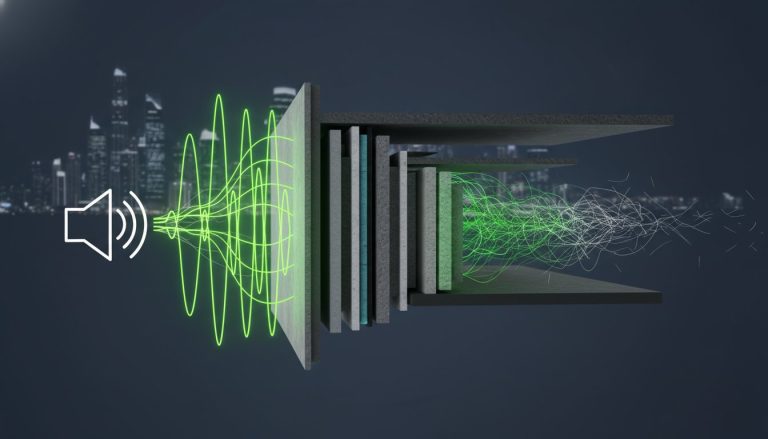
Choosing the right hardware depends entirely on the noise spectrum. Circular silencers excel in high-frequency attenuation for smaller ducts, while rectangular splitters are better suited for large-scale air handling units. In dense urban areas like Dubai Marina, acoustic louvres become essential barriers that prevent mechanical hum from disturbing neighboring properties. These louvres allow for necessary ventilation while blocking line-of-sight noise paths. Applying high-density acoustic lining within plenums reduces low-frequency rumble by absorbing energy before it enters the main duct network.
Active Isolation: Floating Floors and Spring Mounts
Vibration is often more disruptive than airborne sound in luxury UAE residential towers. Heavy rooftop chillers and pumps require high-deflection spring isolators and concrete inertia bases to prevent structural resonance. In primary plant rooms, we design floating floors that use neoprene or spring mounts to decouple the mechanical energy from the main slab. It’s critical that this isolation remains clean; even a single rigid pipe or duct crossing the isolation joint can bypass the entire system. Using flexible connectors for all services ensures the vibration stays contained within the machine base. This mechanical precision works best when paired with thoughtful Architectural Acoustics, ensuring the room’s surfaces don’t amplify the very equipment we’re trying to quiet. For MEP teams managing complex installations, our comprehensive vibration isolation dubai checklist provides practical guidance to prevent costly post-handover failures.
A one-size-fits-all approach to hvac noise control dubai ignores the reality of acoustics. A silencer that works for a 1,500 AED residential fan won’t satisfy the requirements of a 50,000 AED commercial air handling unit. Precision in selection ensures that the final result provides the requested silence without inflating operational costs or requiring expensive post-installation retrofits.
Integrating Acoustic Design into the MEP Coordination Process
Successful MEP coordination requires more than just fitting pipes and ducts into a constrained ceiling void. It demands a proactive strategy where acoustic integrity is treated as a core performance metric. For projects involving hvac noise control dubai, the process begins with defining specific Noise Criterion (NC) or Room Criteria (RC) levels. A luxury residential bedroom in Downtown Dubai might require an NC 25 rating, while a commercial lobby functions perfectly at NC 40.
The coordination workflow follows five essential stages to ensure engineering precision:
- Design Criteria: We establish target decibel levels based on the specific use of each internal space.
- Acoustic Modeling: Using digital simulations helps map sound paths and identify potential leaks or resonance before a single duct is hung.
- Layout Review: Our teams pinpoint high-risk zones where large Air Handling Units (AHUs) sit adjacent to quiet areas like boardrooms or bedrooms.
- Procurement Specification: We define the exact insertion loss, which is the measure of noise reduction provided by a silencer, so contractors purchase the correct components.
- Site Inspection: Professional oversight ensures that vibration isolators and flexible connections are installed without bridging, which could otherwise allow sound to bypass the treatment.
Early-Stage Acoustic Modeling and Simulation
Engineers use specialized software to create a digital twin of the building’s acoustic environment. This 3D modeling identifies noise bottlenecks in complex duct networks that are often invisible on 2D plans. By simulating air turbulence and fan noise early, MEP teams avoid the high costs of post-construction fixes. Correcting a noise issue during the design phase might cost 4,500 AED in engineering time; however, a physical retrofit after handover could easily exceed 60,000 AED in material and labor costs. It’s a matter of financial logic as much as it’s about comfort. This principle is equally critical in large-scale projects, as detailed in our guide on designing quiet plant rooms in Saudi Arabian megaprojects, where early acoustic input significantly reduces design risk.
Verification through On-Site Acoustic Testing
The final stage of the coordination process involves physical sound level measurements. This step confirms that the installed systems meet the specified design targets. We provide formal documentation for project stakeholders and regulatory authorities, ensuring the building complies with local standards set by the Dubai Municipality. This rigorous process transforms the “invisible” element of sound into a verifiable asset. You can explore our final quality assurance protocols by visiting our page on Acoustic Testing and Verification.
Partnering with Specialist Consultants for Acoustic Excellence
Achieving superior acoustic comfort in the UAE’s demanding climate requires more than just high-quality silencers; it demands an objective, expert perspective. Independent acoustic consultants provide guidance that remains untethered from product sales or manufacturer quotas. While a product supplier might focus on selling specific hardware, an independent consultant evaluates the entire system’s physics to ensure the most efficient outcome. This unbiased approach is essential for effective hvac noise control dubai, where high-capacity systems are necessary to combat extreme outdoor temperatures. We act as the vital link between the visionary goals of architects and the functional requirements of MEP engineers, ensuring that technical performance never compromises the project’s design intent.
The Focus Acoustics Approach to Building Services
Our methodology prioritizes engineering precision alongside sustainable design principles. We don’t view acoustics as a secondary concern or a post-design fix. Instead, we treat sound as a fundamental element of the building’s identity. By aligning technical specifications with the aesthetic goals of the architectural team, we ensure that bulky acoustic treatments don’t interfere with the interior’s visual harmony. For complex developments like luxury hospitality projects or high-density residential towers in the Emirates, we provide bespoke advisory services that address unique geometric challenges and stringent performance requirements. Our goal is to create spaces where the silence is as carefully designed as the structure itself.
From Design Review to Close-Out
Acoustic success depends on continuous stakeholder alignment from the initial design review to the final handover. Errors during the installation phase are common and can lead to remedial costs exceeding 45,000 AED for even modest commercial units. Our team provides active Construction Support to help contractors resolve on-site installation challenges in real-time. This hands-on involvement prevents minor oversights from becoming permanent defects.
We also conduct rigorous reviews during the Defect Liability Period to verify that the hvac noise control dubai systems perform as promised long after the building is occupied. This end-to-end involvement secures the developer’s investment and guarantees long-term acoustic harmony for the end-user. Detailed verification ensures that every decibel level meets the local regulatory standards and international best practices. To avoid costly stop-work orders and regulatory delays, developers should consider conducting a comprehensive environmental noise assessment dubai before finalizing MEP plant selections and rooftop layouts. For MEP teams seeking to minimize commercial risk, implementing a systematic approach to vibration isolation dubai during the construction phase prevents expensive post-handover failures.
Contact Focus Acoustics today to discuss the acoustic requirements of your next project and ensure a legacy of quiet, functional elegance.
Securing Acoustic Harmony for Dubai’s 2026 Skyline
As the United Arab Emirates prepares for its next wave of landmark developments, the integration of acoustics into the MEP coordination process has become a fundamental requirement for luxury environments. Effective hvac noise control dubai strategies rely on addressing both airborne sounds and structural vibrations during the early design phases. This proactive approach prevents the need for disruptive retrofits that can often cost developers upwards of 200,000 AED in high-end residential towers. By aligning mechanical performance with architectural elegance, projects achieve a level of quietude that defines modern premium living.
Focus Acoustics, an independent specialist consultancy founded in 2021, brings technical rigor to these challenges. We offer expertise across the hospitality, residential, and entertainment sectors, providing comprehensive support that spans from initial design modeling to final on-site verification. Our role is to ensure that your building services function with silent precision, allowing the design’s aesthetic value to remain the primary focus. For developers seeking to minimize acoustic risks and protect their investment, working with an experienced acoustic design consultant Dubai from the concept stage helps avoid costly coordination failures and post-handover complaints. When evaluating potential partners, it’s essential to hire acoustic consultant dubai specialists who understand both the technical requirements and commercial realities of the region’s demanding construction environment. Partner with Focus Acoustics for your next project to create spaces where engineering excellence and acoustic serenity coexist perfectly. We look forward to helping you build a quieter, more refined future for the city.
Frequently Asked Questions
What are the acceptable noise levels for HVAC systems in the UAE?
In the UAE, acceptable HVAC noise levels typically span from NC 25 to NC 35 for residential bedrooms and NC 35 to NC 45 for commercial office spaces. These benchmarks align with Dubai Municipality Circular No. 161 and international ASHRAE standards to ensure internal acoustic comfort. Precise adherence to these Noise Criteria (NC) curves is vital for MEP teams to avoid post-construction remediation costs. We focus on achieving these targets through a blend of engineering precision and functional elegance.
How do I reduce noise from a rooftop chiller?
Reducing rooftop chiller noise requires a dual approach of vibration isolation and acoustic screening. You’ll need to install spring mounts or inertia bases to stop mechanical energy from entering the building structure. For airborne sound, acoustic barriers or louvers should be positioned based on 3D sound propagation modeling. Proper hvac noise control dubai projects often require barriers that are 1.5 times the height of the chiller to effectively shield neighboring properties from sound pressure levels.
What is the difference between airborne and structure-borne HVAC noise?
Airborne noise travels through the atmosphere; it’s the sound of air rushing through a supply grille or a humming fan motor. Structure-borne noise occurs when mechanical vibrations move through concrete slabs or steel beams, eventually radiating as audible sound in distant rooms. Each type demands a unique solution. Airborne issues require sound-absorbing materials or silencers; structure-borne problems necessitate decoupling the equipment from the building’s skeleton using high-quality resilient mounts.
Can acoustic silencers affect HVAC airflow efficiency?
Acoustic silencers can impact airflow efficiency by creating a pressure drop within the ductwork. If the silencer isn’t sized correctly, the fan must work harder and consume more energy to maintain the required air change rates. It’s crucial to select attenuators that balance acoustic performance with aerodynamic transparency. We ensure that every silencer integration maintains the system’s energy efficiency while preserving the quiet, premium environment our clients expect.
When should an acoustic consultant be involved in an MEP project?
You should involve an acoustic consultant during the schematic design phase of any UAE development. Early collaboration allows for the strategic placement of plant rooms and optimized duct layouts before the architectural footprint is finalized. This proactive strategy is approximately 5 to 10 times more cost-effective than attempting to fix acoustic failures after the building’s completion. It ensures that technical excellence and aesthetic harmony are woven into the project’s foundation.
Are there specific noise regulations for residential buildings in the UAE?
Residential projects in the UAE must comply with strict environmental noise limits set by local authorities like the Dubai Municipality or Abu Dhabi Department of Municipalities and Transport. These regulations dictate that internal noise levels shouldn’t exceed specific decibel thresholds to protect residents from building service equipment. Implementing professional hvac noise control dubai solutions ensures your project meets these legal requirements while providing the serene atmosphere essential for high-end living. The same early-stage discipline that governs HVAC acoustic design is equally critical when addressing plumbing noise control qatar challenges in neighbouring Gulf high-rise developments, where pipe discharge through ceiling voids presents comparable remediation risks once buildings are occupied.